
LNG Pipework Integrity Confirmed During Temperature Change
Real-time displacement monitoring confirmed header movement remained within acceptable limits
EnergyServices provided
Condition Monitoring Pipework Vibration Assessment Stress & Fatigue Assessment Structural Integrity Monitoring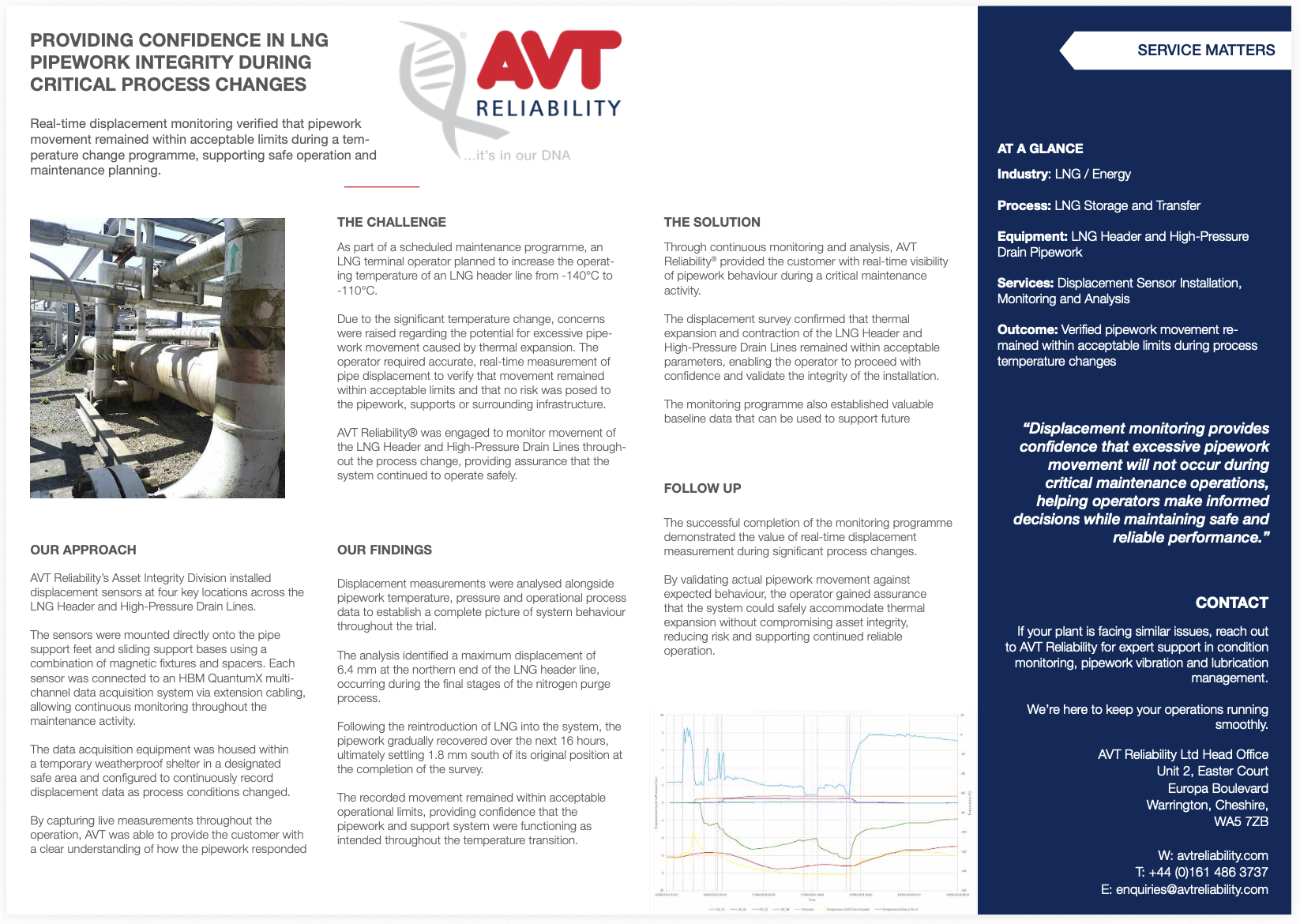
Working to Achieve
Real-time displacement monitoring verified that pipework movement remained within acceptable limits during a temperature change programme, supporting safe operation and maintenance planning.
The Challenge
As part of a scheduled maintenance programme, an LNG terminal operator planned to increase the operating temperature of an LNG header line from -140°C to -110°C.
Due to the significant temperature change, concerns were raised regarding the potential for excessive pipe- work movement caused by thermal expansion. The operator required accurate, real-time measurement of pipe displacement to verify that movement remained within acceptable limits and that no risk was posed to the pipework, supports or surrounding infrastructure.
AVT Reliability® was engaged to monitor movement of the LNG Header and High-Pressure Drain Lines throughout the process change, providing assurance that the system continued to operate safely.
Our Approach
AVT Reliability’s Asset Integrity Division installed displacement sensors at four key locations across the LNG Header and High-Pressure Drain Lines. The sensors were mounted directly onto the pipe support feet and sliding support bases using a combination of magnetic fixtures and spacers. Each sensor was connected to an HBM QuantumX multi- channel data acquisition system via extension cabling, allowing continuous monitoring throughout the maintenance activity.
The data acquisition equipment was housed within a temporary weatherproof shelter in a designated safe area and configured to continuously record displacement data as process conditions changed. By capturing live measurements throughout the operation, AVT was able to provide the customer with a clear understanding of how the pipework responded.
Our Findings
Displacement measurements were analysed alongside pipework temperature, pressure and operational process data to establish a complete picture of system behaviour throughout the trial. The analysis identified a maximum displacement of 6.4 mm at the northern end of the LNG header line, occurring during the final stages of the nitrogen purge process. Following the reintroduction of LNG into the system, the pipework gradually recovered over the next 16 hours, ultimately settling 1.8 mm south of its original position at the completion of the survey. The recorded movement remained within acceptable operational limits, providing confidence that the pipework and support system were functioning as intended throughout the temperature transition.
The Solution
Through continuous monitoring and analysis, AVT Reliability® provided the customer with real-time visibility of pipework behaviour during a critical maintenance activity.
The displacement survey confirmed that thermal expansion and contraction of the LNG Header and High-Pressure Drain Lines remained within acceptable parameters, enabling the operator to proceed with confidence and validate the integrity of the installation. The monitoring programme also established valuable baseline data that can be used to support future
Follow-Up
The successful completion of the monitoring programme demonstrated the value of real-time displacement measurement during significant process changes. By validating actual pipework movement against expected behaviour, the operator gained assurance that the system could safely accommodate thermal expansion without compromising asset integrity, reducing risk and supporting continued reliable operation.
"Displacement monitoring provides confidence that excessive pipework movement will not occur during critical maintenance operations, helping operators make informed decisions while maintaining safe and reliable performance."
AVT Reliability Engineer


