Pump Performance Testing
Service‑led, technology‑enabled. Performance and compliance for critical pumps
Pump Performance Testing
What is pump performance testing?
Pump performance testing measures head pressure against flow rate and plots the results on a performance curve. This shows how a pump performs in real operating conditions compared with its expected duty or theoretical best efficiency point.
The results help verify capability, identify inefficiencies, confirm compliance with site requirements and support practical remedial action where performance has fallen below the required standard.
Performance testing helps prove:
Flow capability
The pump can deliver the required volume under duty conditions.
Pressure performance
The pump can meet the required head or discharge pressure.
Operational readiness
The asset is ready to perform when required, especially in critical applications.
Pump Performance Testing
What is pump performance testing?
Pump performance testing measures head pressure against flow rate and plots the results on a performance curve. This shows how a pump performs in real operating conditions compared with its expected duty.
The results help verify capability, identify inefficiencies, confirm compliance and support remedial action where performance is below requirement.
Performance testing helps prove:
Flow capability
The pump can deliver the required volume under duty conditions.
Pressure performance
The pump can meet the required head or discharge pressure.
Operational readiness
The asset is ready to perform when required.
Critical Pump Verification
Where it is used and why it matters
Testing is commonly carried out on firewater pumps to help demonstrate that systems can deliver the required duty in an emergency. It can also be applied to other critical pumps where performance, reliability and safety are essential.
Firewater pumpsUsed on offshore and onshore installations where emergency response capability must be proven. |
Critical process pumpsSuitable for seawater, cooling water and process pumps where performance affects production, safety or compliance. |
Performance standardsHelps verify actual pump performance against site requirements, OEM data and annual review evidence. |
Critical Pump Verification
Where it is used and why it matters
Testing is commonly carried out on firewater pumps to help demonstrate that systems can deliver the required duty in an emergency. It can also be applied to other critical pumps where performance, reliability and safety are essential.
Firewater pumps
Used on offshore and onshore installations where emergency response capability must be proven.
Critical process pumps
Suitable for seawater, cooling water and process pumps where performance affects production, safety or compliance.
Performance standards
Helps verify actual pump performance against site requirements, OEM data and annual review evidence.
Case Study
Offshore firewater pump performance testing
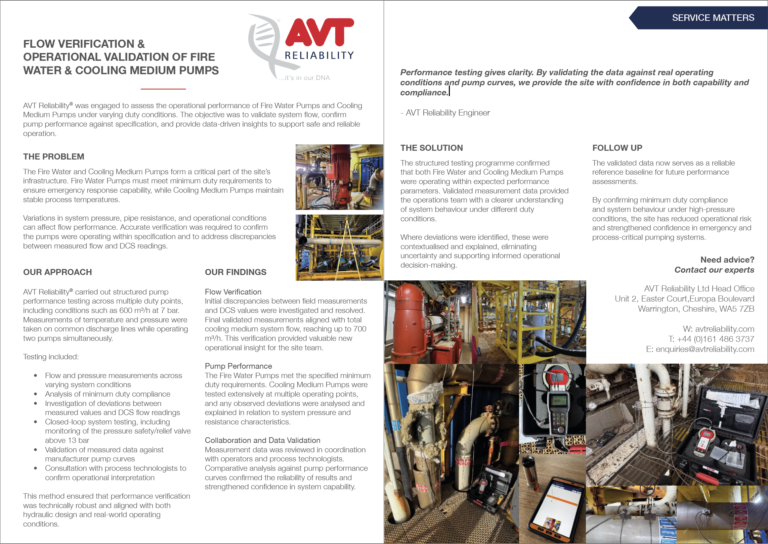
An offshore platform required verification that a diesel engine driven firewater pump could meet the required emergency duty.
At a glance
Industry: Oil and Gas
Location: North Sea
Equipment: Diesel driven firewater pump
Process: Seawater for fire suppression
Service: Firewater pump performance testing
The challenge
The platform had two diesel driven firewater pumps. Each pump needed to meet 100% of the firewater demand with full redundancy. The required standard was 1268 m³/h at 7.7 bar. One pump had failed a prior test, and AVT Reliability was asked to investigate.
Our approach
We installed ultrasonic transducers on discharge and cooling lines, used a digital pressure gauge on the discharge tapping point and measured speed using a digital tachometer. Flow was recorded across 7.2 to 10 bar in approximately 0.5 bar increments.
Findings and solution
Initial results showed under-performance. At 7.7 bar, the pump delivered approximately 1260 m³/h, below the 1268 m³/h requirement. We identified that measured speed was lower than OEM data. With the customer’s agreement, engine speed was increased by 25 rpm and the pump was re-tested.
The result
The pump achieved 1277.64 m³/h at 7.7 bar, exceeding the minimum requirement and restoring confidence in emergency pump performance.
Case Study
Offshore firewater pump performance testing
An offshore platform required verification that a diesel engine driven firewater pump could meet the required emergency duty.
At a glance
Industry: Oil and Gas
Location: North Sea
Equipment: Diesel driven firewater pump
Service: Firewater pump performance testing
The challenge
The pump needed to meet 1268 m³/h at 7.7 bar. One pump had failed a prior test, and AVT Reliability was asked to investigate.
Our approach
We measured flow, discharge pressure and speed, recording data across 7.2 to 10 bar in approximately 0.5 bar increments.
Findings and solution
Initial results showed under-performance. Engine speed was increased by 25 rpm with the customer’s agreement, then the pump was re-tested.
The result
The pump achieved 1277.64 m³/h at 7.7 bar, exceeding the minimum requirement.
 |
 |
 |
How We Test
A practical process for measuring real pump performance
AVT Reliability uses field measurement, curve assessment and engineering interpretation to verify pump duty and identify corrective actions.
|
1
Instrument setupFit ultrasonic flowmeters, pressure gauge and tachometer to capture key operating data. |
2
Data captureRecord flow, pressure and rpm across the required test range and duty points. |
3
Curve assessmentPlot head versus flow and compare measured performance against OEM or site requirements. |
4
RecommendationsProvide corrective actions and verify improvement with follow-up testing where applicable. |
How We Test
A practical process for measuring real pump performance
AVT Reliability uses field measurement, curve assessment and engineering interpretation to verify pump duty and identify corrective actions.
Instrument setup
Fit ultrasonic flowmeters, pressure gauge and tachometer to capture key operating data.
Data capture
Record flow, pressure and rpm across the required test range and duty points.
Curve assessment
Plot head versus flow and compare measured performance against OEM or site requirements.
Recommendations
Provide corrective actions and verify improvement with follow-up testing where applicable.
What You Receive
Clear evidence for performance, compliance and action
Performance curve with recorded head versus flow
Measured flow, pressure and speed with test conditions
Gap-to-standard analysis against OEM or site requirements
Recommendations to restore or improve performance
Formal report suitable for audits and annual reviews
Verified performanceHead versus flow curve proves whether each pump can meet duty when required. |
Reduced riskIdentify shortfalls early and act before failures, derates or compliance issues arise. |
Compliance supportProvides evidence for performance standards, safety requirements and audit reviews. |
Actionable reportingClear recommendations, with before and after results where corrective action is applied. |
What You Receive
Clear evidence for performance, compliance and action
Performance curve with recorded head versus flow
Measured flow, pressure and speed with test conditions
Gap-to-standard analysis
Recommendations to restore or improve performance
Formal report for audits and annual reviews
Verified performance
Head versus flow curve proves whether each pump can meet duty when required.
Reduced risk
Identify shortfalls early and act before failures, derates or compliance issues arise.
Compliance support
Provides evidence for performance standards, safety requirements and audit reviews.
Actionable reporting
Clear recommendations, with before and after results where corrective action is applied.
Talk to AVT Reliability
Ready to get started?
Use the form below to contact our team and find out more about pump performance testing, firewater pump verification and critical pump performance assessment.
Need to verify critical pump performance?
Tell us about your pump, duty requirement or compliance concern and our team will help identify the right next step.
Talk to AVT Reliability
Ready to get started?
Use the form below to contact our team and find out more about pump performance testing, firewater pump verification and critical pump performance assessment.
Need to verify critical pump performance?
Tell us about your pump, duty requirement or compliance concern and our team will help identify the right next step.
window.addEventListener(‘DOMContentLoaded’, function () {
if (window.hbspt) {
hbspt.forms.create({
region: “na1”,
portalId: “3317862”,
formId: “4ebf37f1-b130-40ba-8f63-942814c26d11”,
target: “#avt-contact-form”,
onFormSubmit: function ($form) {
console.log(“HubSpot form submitted — pushing to dataLayer”);
window.dataLayer = window.dataLayer || [];
window.dataLayer.push({
event: ‘hubspot_form_submitted’,
form_name: ‘AVT Contact Page’
});
}
});
} else {
console.warn(“HubSpot not available”);
}
});
Pump Performance Testing – FAQs
What is a pump performance curve?
It’s a graph of head (pressure) versus flow rate, created from site measurements. Comparing the measured curve with OEM or site standards shows whether the pump delivers the required duty in real operating conditions.
How often should firewater pumps be tested?
In the UK oil & gas sector, operators commonly test firewater pumps annually as part of performance standards and assurance programmes. Your site standard or safety case will specify exact intervals.
Which instruments are used during testing?
Typical instrumentation includes ultrasonic flowmeters (for discharge/cooling lines), a digital pressure gauge (pump discharge tapping), and a digital tachometer (with reflective tape) to record speed (rpm).
What if the pump underperforms?
We identify the shortfall, compare against the performance standard, and recommend corrective actions (e.g., speed adjustment within OEM limits, maintenance, or component changes). A follow-up test verifies improvement.
Is testing only for firewater pumps?
No. While many projects involve firewater pumps, the same methodology applies to seawater, cooling water and other critical process pumps where performance, reliability and safety are essential.
What deliverables will we receive?
You’ll receive the measured curve (head vs flow), recorded test points and conditions, comparison against site/OEM requirements, and clear, actionable recommendations in a formal report.