
Pipe Strain Monitoring
Compressor discharge pipe strain monitoring
Food & beverageServices provided
Finite Element Analysis (FEA) Pipework Vibration Assessment Remote Diagnostics Stress & Fatigue Assessment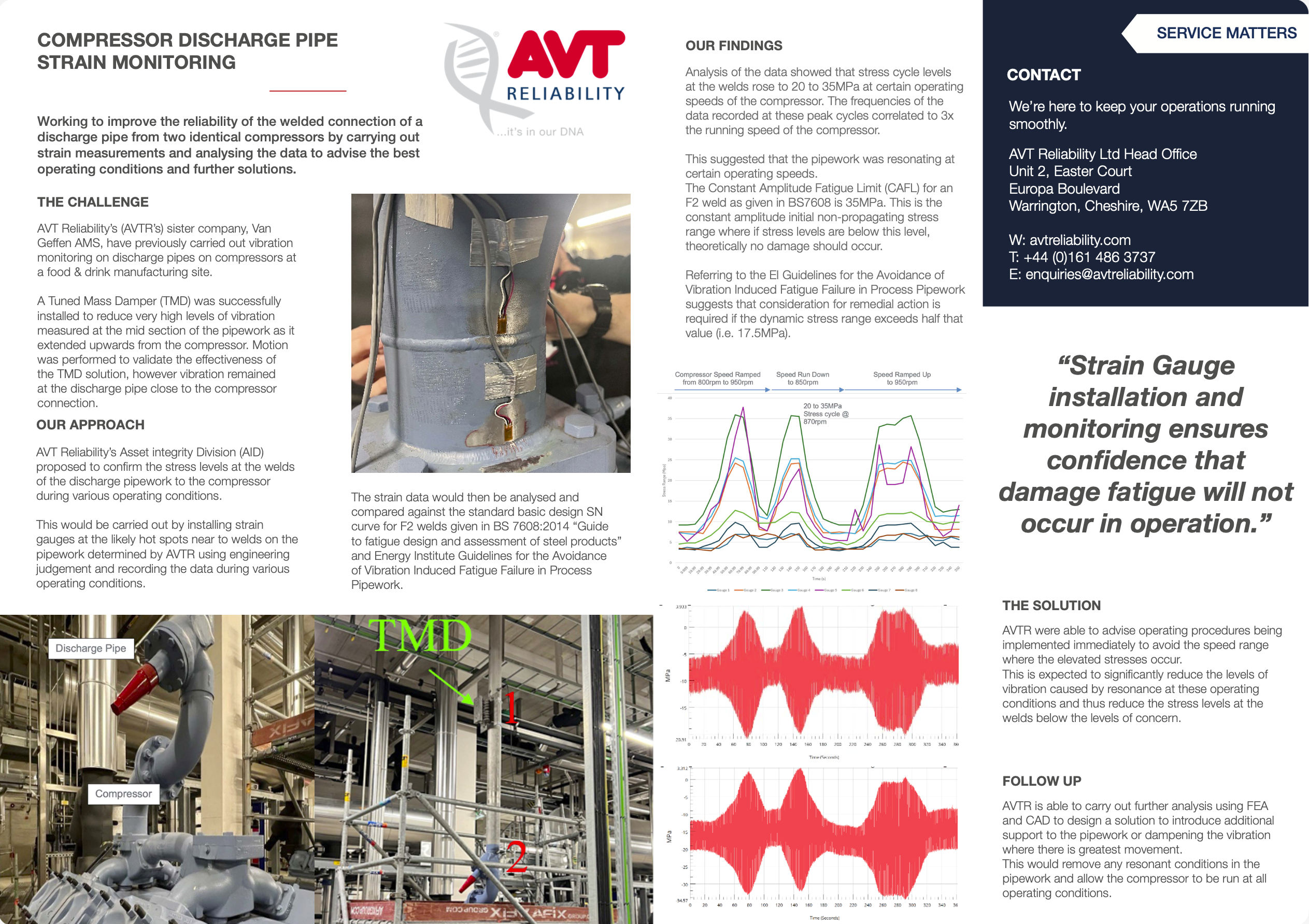
Working to Achieve
Working to improve the reliability of the welded connection of a discharge pipe from two identical compressors by carrying out strain measurements and analysing the data to advise the best operating conditions and further solutions.
The Challenge
AVT Reliability EU, have previously carried out vibration monitoring on discharge pipes on compressors at a food & drink manufacturing site. A Tuned Mass Damper (TMD) was successfully installed to reduce very high levels of vibration measured at the mid section of the pipework as it extended upwards from the compressor. Motion was performed to validate the effectiveness of the TMD solution, however vibration remained at the discharge pipe close to the compressor connection.
Our Approach
AVT Reliability’s Asset integrity Division (AID) proposed to confirm the stress levels at the welds of the discharge pipework to the compressor during various operating conditions. This would be carried out by installing strain gauges at the likely hot spots near to welds on the pipework determined by AVTR using engineering judgement and recording the data during various operating conditions.
The strain data would then be analysed and compared against the standard basic design SN curve for F2 welds given in BS 7608:2014 “Guide to fatigue design and assessment of steel products” and Energy Institute Guidelines for the Avoidance of Vibration Induced Fatigue Failure in Process Pipework.
Our Findings
Analysis of the data showed that stress cycle levels at the welds rose to 20 to 35MPa at certain operating speeds of the compressor. The frequencies of the data recorded at these peak cycles correlated to 3x the running speed of the compressor.
This suggested that the pipework was resonating at certain operating speeds. The Constant Amplitude Fatigue Limit (CAFL) for an F2 weld as given in BS7608 is 35MPa. This is the constant amplitude initial non-propagating stress range where if stress levels are below this level, theoretically no damage should occur. Referring to the EI Guidelines for the Avoidance of Vibration Induced Fatigue Failure in Process Pipework suggests that consideration for remedial action is required if the dynamic stress range exceeds half that value (i.e. 17.5MPa).
The Solution
AVTR were able to advise operating procedures being implemented immediately to avoid the speed range where the elevated stresses occur. This is expected to significantly reduce the levels of vibration caused by resonance at these operating conditions and thus reduce the stress levels at the welds below the levels of concern.
Follow-Up
AVTR is able to carry out further analysis using FEA and CAD to design a solution to introduce additional support to the pipework or dampening the vibration where there is greatest movement. This would remove any resonant conditions in the pipework and allow the compressor to be run at all operating conditions.
"Strain Gauge installation and monitoring ensures confidence that damage fatigue will not occur in operation."

