
Ultrasound Identifies Faulty Compressor Unloaders
Abnormal valve activity on a critical flash gas reciprocating compressor was identified before valve failure
Oil & Gas Download Case Study (PDF)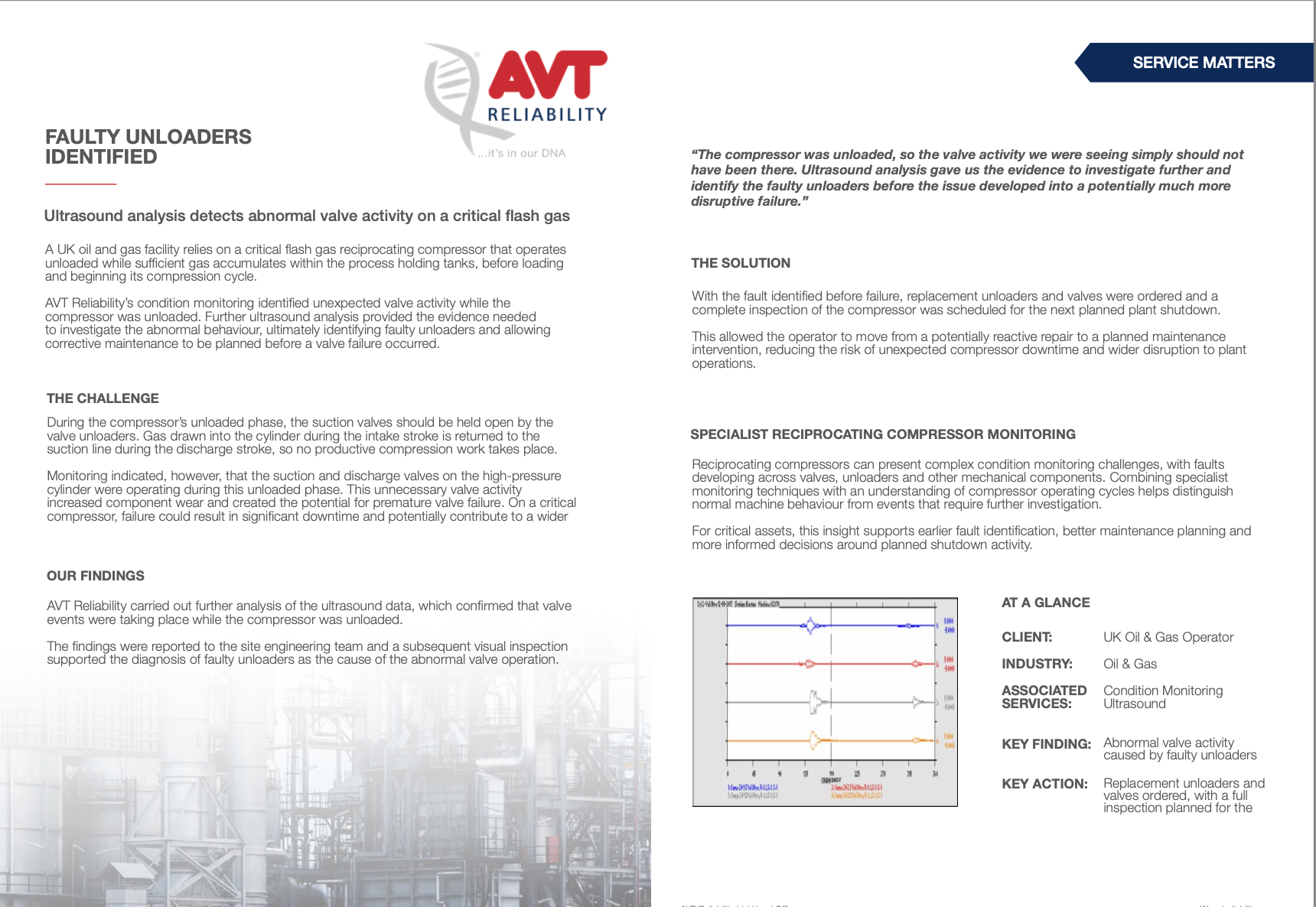
Working to Achieve
A UK oil and gas facility relies on a critical flash gas reciprocating compressor that operates unloaded while sufficient gas accumulates within the process holding tanks, before loading and beginning its compression cycle.
AVT Reliability’s condition monitoring identified unexpected valve activity while the compressor was unloaded. Further ultrasound analysis provided the evidence needed to investigate the abnormal behaviour, ultimately identifying faulty unloaders and allowing corrective maintenance to be planned before a valve failure occurred.
The Challenge
During the compressor’s unloaded phase, the suction valves should be held open by the valve unloaders. Gas drawn into the cylinder during the intake stroke is returned to the suction line during the discharge stroke, so no productive compression work takes place.
Monitoring indicated, however, that the suction and discharge valves on the high-pressure cylinder were operating during this unloaded phase. This unnecessary valve activity increased component wear and created the potential for premature valve failure. On a critical compressor, failure could result in significant downtime and potentially contribute to a wider
Our Findings
AVT Reliability carried out further analysis of the ultrasound data, which confirmed that valve events were taking place while the compressor was unloaded.
The findings were reported to the site engineering team and a subsequent visual inspection supported the diagnosis of faulty unloaders as the cause of the abnormal valve operation.
“The compressor was unloaded, so the valve activity we were seeing simply should not have been there. Ultrasound analysis gave us the evidence to investigate further and identify the faulty unloaders before the issue developed into a potentially much more disruptive failure.”
The Solution
With the fault identified before failure, replacement unloaders and valves were ordered and a complete inspection of the compressor was scheduled for the next planned plant shutdown.
This allowed the operator to move from a potentially reactive repair to a planned maintenance intervention, reducing the risk of unexpected compressor downtime and wider disruption to plant operations.
Follow-Up
Reciprocating compressors can present complex condition monitoring challenges, with faults developing across valves, unloaders and other mechanical components. Combining specialist monitoring techniques with an understanding of compressor operating cycles helps distinguish normal machine behaviour from events that require further investigation.
For critical assets, this insight supports earlier fault identification, better maintenance planning and more informed decisions around planned shutdown activity.
At a Glance
- Client: UK Oil Refinery Operator
- Industry: Oil & Gas
- Associated services: Condition Monitoring; Vibration Analysis
- Key findings: Abnormal valve activity caused by faulty unloaders
- Key action: Continued monitoring identified escalating internal damage, allowing the compressor to be taken offline before a potential


