Pipework Vibration Monitoring with Machine Sentry
Machine Sentry Beyond Machines: Pipework Vibration Monitoring
Machine Sentry is often associated with rotating equipment, but vibration monitoring can also play an important role in understanding the behaviour of pipework, supports and small-bore connections.
For process systems, excessive or changing vibration can increase fatigue risk, particularly where small-bore connections, branch lines or associated equipment are exposed to repeated dynamic movement.
That makes pipework vibration monitoring an important part of a wider Asset Integrity strategy.
Why pipework vibration matters
Pipework does not need to fail dramatically for vibration to become a concern.
Repeated movement can gradually increase fatigue damage, particularly at vulnerable locations such as:
- small-bore connections
- branch connections
- supports and restraints
- instrument connections
- welded attachments
- areas affected by flow-induced vibration or resonance
The visible movement may appear minor, but repeated cyclic loading can still create a long-term integrity risk.
For that reason, the objective of pipework vibration monitoring is not simply to identify where something is moving. It is to understand the level, pattern and persistence of that movement and determine whether further engineering assessment is required.
Using Machine Sentry beyond rotating equipment
Machine Sentry sensors can be used to collect vibration data from pipework and structural locations as well as conventional rotating assets.
This can be valuable where engineers need to:
- compare vibration levels between locations
- monitor changes over time
- identify assets or connections requiring closer investigation
- capture vibration during different process conditions
- validate the effect of mitigation work
Fixed monitoring can also help where access is difficult or where the behaviour of the pipework changes with operating conditions.
Rather than relying on a single site visit, data can be collected over a longer period to provide a better picture of how the system behaves.
From monitoring to engineering assessment
Monitoring is only the first part of the process.
Where elevated or unusual vibration is identified, the data can support a more detailed pipework vibration assessment.
Depending on the application, that may include:
- additional vibration measurements
- strain measurement
- Motion Amplification
- Operating Deflection Shape analysis
- Experimental Modal Analysis
- Finite Element Analysis
- fatigue assessment
The purpose is to move from identifying a vibration concern to understanding the underlying mechanical behaviour and the associated risk.
Small-bore connections are particularly vulnerable
Small-bore connections are a common area of concern because their geometry can make them more susceptible to vibration-induced fatigue.
Repeated movement at the connection can increase stress at vulnerable locations, particularly where the connection is poorly supported or exposed to resonance.
Machine Sentry can help identify changing or elevated vibration at these locations, allowing engineering teams to prioritise further assessment.
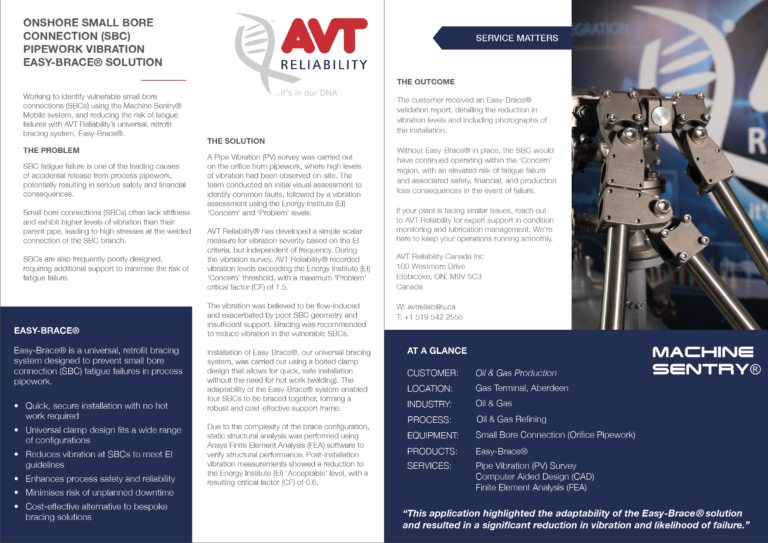
Where mitigation is required, solutions such as Easy-Brace can provide additional support to reduce damaging movement without the need for a fully bespoke fabricated brace.
The effectiveness of any mitigation should then be verified by measurement rather than assumed.
Measuring before and after mitigation
One of the most useful applications of vibration monitoring is validation.
A mitigation measure may look effective visually, but the important question is whether it has actually reduced the dynamic response of the system.
Pre- and post-intervention measurements allow engineers to compare vibration levels and confirm whether the modification has achieved the intended result.
This creates a much stronger engineering basis for decision-making than relying on observation alone.
A wider view of condition monitoring
Condition monitoring is often thought of as a way to detect bearing, gearbox or motor faults.
In reality, the same principle can be applied much more widely.
By using measured data to understand how assets and structures behave over time, reliability teams can identify developing problems earlier and make better-informed maintenance and engineering decisions.
For pipework systems, Machine Sentry can provide that first layer of visibility, helping identify where further investigation may be required and supporting the validation of corrective action.
AVT Reliability combines pipework vibration monitoring, specialist Asset Integrity engineering and practical mitigation solutions to help organisations understand and control vibration-related risk.