Offshore Pipework Fatigue Investigation
From Repeated Failure to Root Cause
Repeated pipework failures are a strong indication that replacing the failed component alone may not resolve the underlying problem.
On an offshore oil platform, recurring issues within the pipework system prompted a wider investigation into how vibration, operating conditions and local structural behaviour were affecting integrity.
AVT Reliability combined field measurements, engineering assessment and expertise from across its regional teams to understand the problem and determine whether vibration-induced fatigue was contributing to the repeated failures.
Repeated failure needs a wider investigation
When the same area of pipework experiences repeated problems, there is a risk that each individual failure is treated as an isolated event.
Repairing or replacing the damaged component may restore operation, but if the underlying dynamic behaviour remains unchanged, the same mechanism can continue to act on the system.
An offshore pipework fatigue investigation therefore needs to look beyond the visible damage.
Engineers need to establish:
- how the pipework is moving
- what is exciting that movement
- where dynamic stresses are concentrated
- whether operating conditions influence the response
- whether the observed behaviour creates a credible fatigue risk
This shifts the focus from repair to root-cause understanding.
Measuring how the pipework behaves
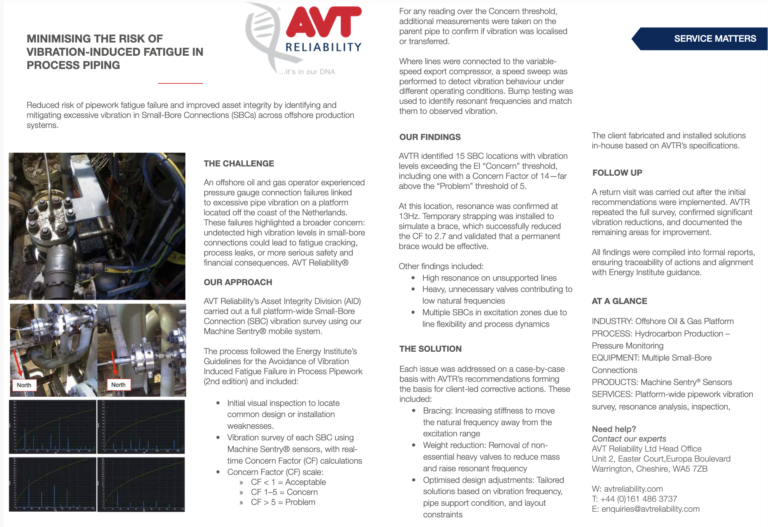
The investigation included vibration measurements across the affected pipework.
These measurements helped establish the amplitude and frequency characteristics of the movement and identify areas requiring closer assessment.
Machine Sentry equipment supported the collection and review of vibration data, providing measured evidence rather than relying purely on visual observations.
This is important because pipework that appears to move significantly is not necessarily the location carrying the greatest fatigue risk.
The frequency, direction and local geometry all influence how vibration translates into stress.
Assessing the likelihood of vibration-induced fatigue
Measured vibration data was then considered against recognised engineering guidance.
This allows engineers to move beyond the question of whether vibration is present and towards the more important question of whether it is severe enough to threaten the integrity of the system.
Guidance from bodies such as the Energy Institute provides structured methods for screening and assessing pipework vibration.
Where the initial assessment indicates elevated risk, more detailed analysis may then be required.
This can include:
- additional vibration measurements
- strain measurement
- stress analysis
- fatigue assessment
- modal analysis
- Finite Element Analysis
- detailed review of supports and connections
The level of investigation should reflect the severity and complexity of the problem.
Why fatigue problems can return after repair
Vibration-induced fatigue is cumulative.
Repeated cyclic loading can gradually initiate and propagate cracks at vulnerable locations, particularly around welded connections, branches, supports and other areas of stress concentration.
If the dynamic loading mechanism remains after a repair, the new component may simply begin accumulating the same fatigue damage again.
That is why repeated failures are such an important warning sign.
The objective should be to understand and control the loading mechanism rather than repeatedly replacing the component affected by it.
Combining local knowledge with specialist expertise
Offshore investigations can require several engineering disciplines.
Site knowledge, condition-monitoring data, pipework integrity assessment and specialist vibration expertise may all contribute to the final diagnosis.
For this investigation, engineers from different AVT Reliability regions worked together to combine the required technical capabilities.
That collaborative model is useful where the problem does not fit neatly within a single discipline or location.
The customer still receives one coordinated engineering investigation, while the technical team can draw on wider expertise where required.
From finding the risk to defining the solution
An offshore pipework fatigue investigation should ultimately provide a basis for action.
Once the behaviour of the system is understood, engineers can determine whether changes are needed to reduce the dynamic response or improve the integrity of vulnerable areas.
Depending on the findings, this might involve changes to:
- pipework supports
- restraints
- local stiffness
- operating conditions
- small-bore connections
- damping arrangements
- component geometry
The correct mitigation depends on the cause.
Adding stiffness to a system affected by resonance, for example, may be appropriate in one application but counterproductive in another.
This is why corrective action should follow diagnosis rather than precede it.
Understanding the system, not just the failure
Repeated pipework failure is rarely something that should be addressed component by component.
A structured investigation combines measured vibration, engineering assessment and fatigue knowledge to understand why the failure mechanism exists in the first place.
AVT Reliability’s Pipework Vibration Assessment and Stress and Fatigue Assessment services help operators identify vibration-related integrity risks and develop appropriate mitigation strategies for complex process systems.