Pump Vibration Troubleshooting with Machine Sentry
Unusual vibration on pumps and motors does not always point to a fault inside the rotating equipment itself.
Sometimes the real cause sits elsewhere in the system, such as the base, supporting structure or surrounding installation.
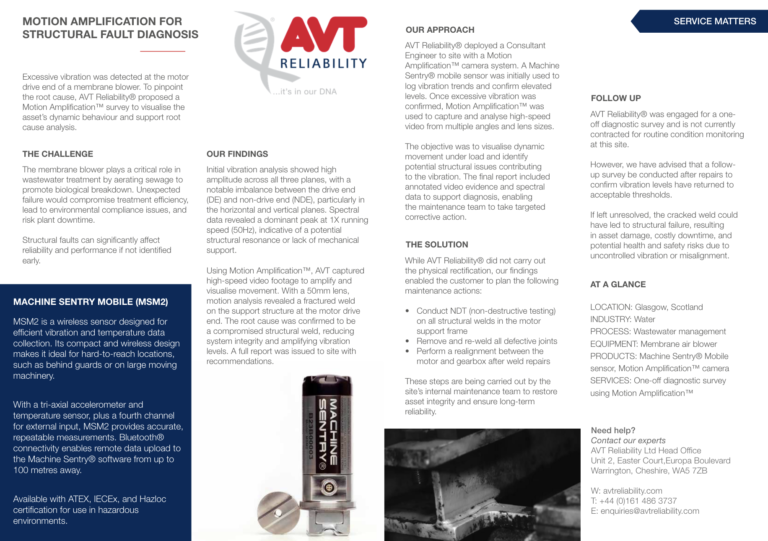
That was the challenge on one customer site, where abnormal vibration behaviour was being seen across a pump and motor arrangement. AVT Reliability used a combination of Machine Sentry Mobile and Machine Sentry Fixed data to investigate the pattern and determine whether the source was mechanical, operational or structural.
The investigation ultimately pointed towards a structural issue requiring further assessment.
Start with the vibration pattern
Effective pump vibration troubleshooting starts by understanding what the machine is actually doing.
A single elevated reading may confirm that something is wrong, but it does not necessarily explain why.
Engineers therefore look for patterns such as:
- changes in vibration amplitude
- recurring spikes
- differences between measurement locations
- changes between operating conditions
- relationships between pump and motor behaviour
- frequency content that may indicate a particular source
Those patterns help narrow the range of possible causes before further investigation begins.
Combining mobile and fixed measurements
Different monitoring methods can provide different parts of the picture.
Machine Sentry Mobile can be used for detailed route-based measurements and targeted investigation at selected points.
Machine Sentry Fixed sensors can provide repeatable measurements from permanently installed locations, helping engineers understand whether unusual behaviour is persistent, intermittent or changing over time.
Using both approaches together can be particularly useful where a problem does not present consistently during a single site visit.
The objective is to build enough evidence to distinguish between a developing machine fault and a response being driven by the wider structure.
Why the obvious diagnosis is not always the right one
Where vibration is detected on a pump or motor, common causes such as imbalance, misalignment, bearing condition or looseness naturally need to be considered.
But not every vibration signature originates within the rotating element.
The machine may instead be responding to:
- structural flexibility
- resonance
- movement within the base or support
- interaction with connected pipework
- excitation from another part of the system
If those possibilities are ignored, maintenance teams can end up repeatedly working on the pump or motor without removing the actual cause.
Looking beyond the rotating equipment
In this case, the vibration behaviour indicated that the issue was not confined to a conventional pump or motor fault.
The pattern pointed towards a structural source.
That changed the direction of the investigation.
Rather than continuing to treat the machine itself as the primary problem, the next step was to examine how the wider installation was moving and responding under operating conditions.
This is where techniques such as Motion Amplification can add value.
By making very small movements visible, Motion Amplification can help engineers understand how the machine, base and surrounding structure move relative to one another.
From condition monitoring to root-cause investigation
Condition monitoring is often the first indication that something has changed.
Troubleshooting then becomes a process of progressively eliminating possible causes.
A typical diagnostic route may involve: vibration data, frequency analysis, comparison between locations, operating-condition review, structural assessment, targeted engineering investigation.
Each stage adds context.
The goal is not simply to confirm that vibration is high, but to understand what is driving it and what corrective action is actually required.
Avoiding unnecessary maintenance
One of the biggest benefits of structured troubleshooting is avoiding work on components that are not the root cause.
If a pump is repeatedly removed, aligned or repaired while the real problem is structural, the vibration is likely to return.
A better diagnosis helps maintenance teams direct effort towards the source rather than the symptom.
That can reduce unnecessary intervention and give greater confidence that corrective work will address the actual problem.
A wider approach to pump vibration troubleshooting
Good pump vibration troubleshooting often requires more than one measurement technique.
Machine Sentry Mobile and Fixed monitoring can provide the vibration evidence, while tools such as Motion Amplification and specialist Vibration Analysis can help determine how the wider system is behaving.
By combining those methods, AVT Reliability can move from abnormal readings to a clearer understanding of the underlying cause and recommend the most appropriate next step.